AGENT BRAND
品牌專題
面對(duì)復(fù)雜多變細(xì)胞模型,您是否為如何精確測(cè)量細(xì)胞內(nèi)的缺氧及氧化應(yīng)激水平而困擾?
是否為一組檢測(cè)而需購(gòu)買2套試劑盒的高昂成本而煩惱?
是否對(duì)傳統(tǒng)的檢測(cè)方法繁瑣且結(jié)果可靠性存疑?
在生命科學(xué)的前沿探索中,準(zhǔn)確評(píng)估細(xì)胞的缺氧與氧化應(yīng)激狀態(tài),對(duì)于揭示疾病機(jī)理、優(yōu)化治療策略至關(guān)重要。如今,Enzo Life Sciences傾情推出ROS-ID Hypoxia/Oxidative Stress Detection Kit(ENZ-51042-0125,ENZ-51042-K500),這是一款專為科研人員設(shè)計(jì),二合一的創(chuàng)新工具,艾美捷為您推薦的ROS-ID 試劑盒直擊這一系列挑戰(zhàn),以其獨(dú)特的雙色熒光標(biāo)記技術(shù),為您帶來(lái)前所未有的清晰視野。它不僅能夠直觀區(qū)分缺氧與氧化應(yīng)激狀態(tài),還能確保實(shí)驗(yàn)結(jié)果的準(zhǔn)確性和重復(fù)性,讓您的研究數(shù)據(jù)更加信服有力。
| 名稱 | 貨號(hào) | 規(guī)格 | 用途 | 檢測(cè)方式 |
| ROS-ID Hypoxia/Oxidative stress detection kit | ENZ-51042-0125 ENZ-51042-K500 | 125T 500T | 活細(xì)胞(懸浮細(xì)胞,貼壁細(xì)胞) | 流式細(xì)胞術(shù),熒光顯微鏡 |
* 可單獨(dú)檢測(cè)低氧,ROS氧化應(yīng)激,亦可同時(shí)檢測(cè)!
高度敏感且特異的熒光探針,可測(cè)量活細(xì)胞中的缺氧和氧化應(yīng)激 適用于附著或懸浮細(xì)胞系 包括ROS和缺氧誘導(dǎo)劑在內(nèi)的完整試劑盒 Enzo Life Sciences的ROS-ID?缺氧/氧化應(yīng)激檢測(cè)套裝旨在功能性檢測(cè)活細(xì)胞(懸浮和附著細(xì)胞均適用)中的缺氧和氧化應(yīng)激水平,可使用熒光顯微鏡或流式細(xì)胞術(shù)。該套裝包括缺氧(紅色)和氧化應(yīng)激水平(綠色)的熒光探針作為兩個(gè)主要組成部分。
實(shí)驗(yàn)原理概述:
1、缺氧檢測(cè)(紅色):缺氧檢測(cè)試劑(Red Hypoxia Detection Reagent)是一種非熒光或弱熒光的芳香族化合物,含有硝基(NO2)基團(tuán)。在缺氧細(xì)胞中,由于存在硝基還原酶活性,硝基團(tuán)通過(guò)一系列化學(xué)反應(yīng)被轉(zhuǎn)化為羥胺(NHOH)和氨基(NH2)基團(tuán),導(dǎo)致原始分子降解并釋放出熒光探針,從而在熒光顯微鏡下呈現(xiàn)紅色熒光。
2、氧化應(yīng)激檢測(cè)(綠色):氧化應(yīng)激檢測(cè)試劑(Oxidative Stress Detection Reagent)為非熒光、細(xì)胞可滲透的總ROS檢測(cè)染料,能直接與多種活性氧物種反應(yīng),如過(guò)氧化氫、過(guò)氧亞硝酸鹽和羥基自由基,生成綠色熒光產(chǎn)物,指示不同類型的ROS/RNS產(chǎn)生。此探針對(duì)超氧化物、活性氯或溴物種相對(duì)不敏感。
產(chǎn)品亮點(diǎn)
1、精準(zhǔn)檢測(cè),雙管齊下:該套件同時(shí)提供綠色熒光的氧化應(yīng)激檢測(cè)試劑與紅色熒光的缺氧檢測(cè)試劑,分別對(duì)應(yīng)細(xì)胞內(nèi)ROS水平與缺氧環(huán)境,實(shí)現(xiàn)精準(zhǔn)定位與定量。
2、廣泛適用,兼容性強(qiáng):無(wú)論是貼壁細(xì)胞還是懸浮細(xì)胞,無(wú)論是采用熒光顯微鏡還是流式細(xì)胞儀,ROS-ID 套件都能靈活適應(yīng),滿足您多樣化的實(shí)驗(yàn)需求。兩種規(guī)格(ENZ-51042-K500與ENZ-51042-0125)量身定制,靈活選擇,經(jīng)濟(jì)高效。
3、操作簡(jiǎn)便,效率提升:我們對(duì)ROS-ID? Hypoxia/Oxidative Stress Detection Mix的準(zhǔn)備過(guò)程進(jìn)行了優(yōu)化,確保實(shí)驗(yàn)準(zhǔn)備簡(jiǎn)單快捷,減少實(shí)驗(yàn)誤差,提升整體研究效率。
4、結(jié)果可視化,直觀可信:實(shí)驗(yàn)設(shè)計(jì)包含正負(fù)對(duì)照,確保每次實(shí)驗(yàn)都有基準(zhǔn)參考,使您的研究結(jié)論更具說(shuō)服力。熒光信號(hào)直觀顯示,細(xì)胞狀態(tài)一目了然,便于數(shù)據(jù)分析與解讀。
結(jié)果分享:
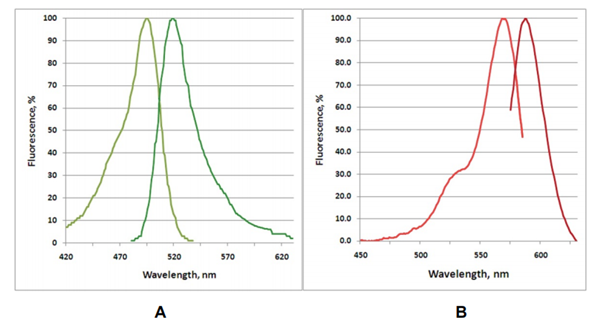
圖 1. 氧化應(yīng)激(A)和低氧(B)檢測(cè)染料的吸收峰和發(fā)射峰分別為504 nm/524 nm和580 nm/595 nm。這些染料可以使用488 nm的氬離子激光器激發(fā),并在大多數(shù)實(shí)驗(yàn)流式細(xì)胞儀的FL3通道(低氧紅染料)和FL1通道(氧化應(yīng)激染料)上檢測(cè)。
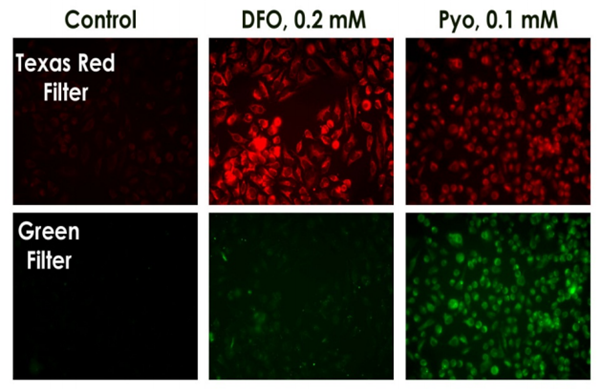
圖 2. HeLa 細(xì)胞被種在顯微鏡載玻片上,第二天按照手冊(cè)描述,用 DFO(低氧的化學(xué)誘導(dǎo)劑)或吡咯烷酮(氧化應(yīng)激誘導(dǎo)劑)處理 4 小時(shí),溫度為 37°C。處理后,載玻片用 PBS 洗滌,蓋上蓋玻片,并使用 Olympus BX-51 熒光顯微鏡進(jìn)行可視化觀察。
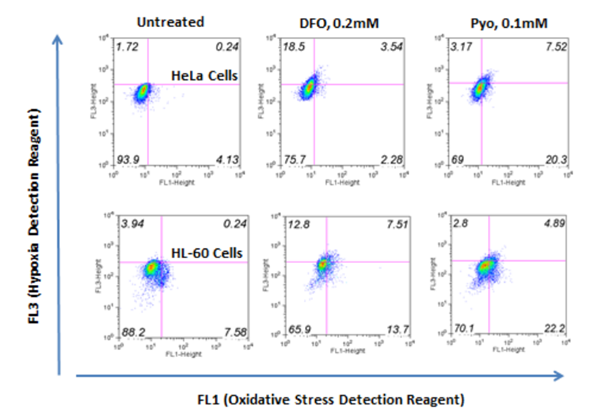
圖3. 培養(yǎng)的人類HeLa和HL-60細(xì)胞中缺氧和氧化應(yīng)激水平的檢測(cè)。細(xì)胞用缺氧誘導(dǎo)劑(DFO)和ROS誘導(dǎo)劑(花青素)處理。每個(gè)象限中的數(shù)字表示細(xì)胞(總體)的百分比。結(jié)果表明,缺氧和氧化應(yīng)激染料具有特異性。
產(chǎn)品詳情:
應(yīng)用:流式細(xì)胞術(shù),熒光顯微鏡,熒光檢測(cè),高通量篩選
應(yīng)用說(shuō)明:此試劑盒設(shè)計(jì)用于使用貼壁或懸浮細(xì)胞進(jìn)行熒光顯微鏡和/或流式細(xì)胞術(shù)。
質(zhì)量控制:使用流式細(xì)胞術(shù)方法進(jìn)行測(cè)試,評(píng)估低氧細(xì)胞和/或具有高水平總氧化應(yīng)激的細(xì)胞,并結(jié)合染料(試劑盒中提供)。還獲得顯微鏡圖像。
數(shù)量:對(duì)于-K500規(guī)格: 500次熒光顯微鏡分析或100次流式細(xì)胞分析。
對(duì)于-0125規(guī)格: 125次熒光顯微鏡分析或25次流式細(xì)胞分析。
使用/穩(wěn)定性:在適當(dāng)?shù)膬?chǔ)存條件下,試劑盒成分穩(wěn)定,直到產(chǎn)品標(biāo)簽上注明的日期。
處理:避免凍融循環(huán)。
運(yùn)輸:干冰
短期儲(chǔ)存:-20°C
長(zhǎng)期儲(chǔ)存:-20°C
更多產(chǎn)品咨詢,歡迎垂詢Enzo中國(guó)區(qū)總代理,艾美捷科技! 400-6800-868,m.zihai029.com
【附錄】發(fā)表文章:
Cupric-ion-promoted fabrication of oxygen-replenishing nanotherapeutics for synergistic chemo and photodynamic therapy against tumor hypoxia: L. He, et al.; Acta Biomater. 162, 57 (2023), Abstract;
Precise manipulation of circadian clock using MnO2 nanocapsules to amplify photodynamic therapy for osteosarcoma: Y.X. Ge, et al.; Mater. Today Bio 19, 100547 (2023), Abstract;
The impact of hypoxia and oxidative stress on proteo-metabolomic alterations of 3D cholangiocarcinoma models: P. Phukhum, et al.; Sci. Rep. 13, 3072 (2023), Abstract;
Dimethyloxalylglycine (DMOG), a Hypoxia Mimetic Agent, Does Not Replicate a Rat Pheochromocytoma (PC12) Cell Biological Response to Reduced Oxygen Culture: R. Chen, et al.; Biomolecules 12, 541 (2022), Abstract;
Hydrogel microcapsules containing engineered bacteria for sustained production and release of protein drugs: C. Han, et al.; Biomaterials 287, 121619 (2022), Abstract;
Inhibiting autophagy flux and DNA repair of tumor cells to boost radiotherapy of orthotopic glioblastoma: Q. Xu, et al.; Biomaterials 280, 121287 (2022), Abstract;
Intracellular glucose starvation affects gingival homeostasis and autophagy: R. Li, et al.; Sci. Rep. 12, 1230 (2022), Abstract;
Intrinsic radical species scavenging activities of tea polyphenols nanoparticles block pyroptosis in endotoxin-induced sepsis: Y. Chen, et al.; ACS Nano 16, 2429 (2022), Abstract;
Iodinated cyanine dye-based nanosystem for synergistic phototherapy and hypoxia-activated bioreductive therapy: Y. Dong, et al.; Drug Deliv. 29, 238 (2022), Abstract;
Lipoprotein-biomimetic nanostructure enables tumor-targeted penetration delivery for enhanced photo-gene therapy towards glioma: R. Wang, et al.; Bioact. Mater. 13, 286 (2022), Abstract;
Microenvironment-driven sequential ferroptosis, photodynamic therapy, and chemotherapy for targeted breast cancer therapy by a cancer-cell-membrane-coated nanoscale metal-organic framework: W.L. Pan ,et al.; Biomaterials 283, 121559 (2022), Abstract;
Mitochondrial glutathione depletion nanoshuttles for oxygen-irrelevant free radicals generation: A cascaded hierarchical targeting and theranostic strategy against hypoxic tumor: B. Liang, et al.; ACS Appl. Mater. Interfaces 14, 13038 (2022), Abstract;
Multifunctional Nanosnowflakes for T1-T2 Double-Contrast Enhanced MRI and PAI Guided Oxygen Self-Supplementing Effective Anti-Tumor Therapy: Y. Lv, et al.; Int. J. Nanomedicine 17, 4619 (2022), Abstract;
Physiologic flow-conditioning limits vascular dysfunction in engineered human capillaries: K. Haase, et al.; Biomaterials 280, 121248 (2022), Abstract;
Platinum prodrug nanoparticles inhibiting tumor recurrence and metastasis by concurrent chemoradiotherapy: W. Jiang, et al.; J. Nanobiotechnology 20, 129 (2022), Abstract;
Strategy for improving cell-mediated vascularized soft tissue formation in a hydrogen peroxide-triggered chemically-crosslinked hydrogel: S.Y. Wei, et al.; J. Tissue. Eng. 13, 20417314221084096 (2022), Abstract; Full Text
A cyclic nano-reactor achieving enhanced photodynamic tumor therapy by reversing multiple resistances: P. Liu, et al.; J. Nanobiotechnology 19, 149 (2021), Abstract; Full Text
An albumin-based therapeutic nanosystem for photosensitizer/protein co-delivery to realize synergistic cancer therapy: S.L. Ai, et al.; ACS Appl. Bio. Mater. 4, 4946 (2021), Abstract;
An injectable hydrogel co-loading with cyanobacteria and upconversion nanoparticles for enhanced photodynamic tumor therapy: X. Zhang, et al.; Colloids Surf. B. Biointerfaces 201, 111640 (2021), Abstract;
Biomimetic nanoreactor for targeted cancer starvation therapy and cascade amplificated chemotherapy: F. Shao, et al.; Biomaterials 274, 120869 (2021), Abstract;
Bone-targeted erythrocyte-cancer hybrid membrane-camouflaged nanoparticles for enhancing photothermal and hypoxia-activated chemotherapy of bone invasion by OSCC: H. Chen, et al.; J. Nanobiotechnology 19, 342 (2021), Abstract; Full Text
Combination of coumarin and doxorubicin induces drug-resistant acute myeloid leukemia cell death: N.S. Al-Abbas, et al.; Heliyon 7, e06255 (2021), Abstract; Full Text
Encapsulating an acid-activatable phthalocyanine–doxorubicin conjugate and the hypoxia-sensitive tirapazamine in polymeric micelles for multimodal cancer therapy: X. Guo, et al.; Biomater. Sci. 9, 4936 (2021), Abstract;
Exploiting the acquired vulnerability of cisplatin-resistant tumors with a hypoxia-amplifying DNA repair-inhibiting (HYDRI) nanomedicine: J. Chen, et al.; Sci. Adv. 7, 5267 (2021), Abstract;
Extracellular matrix-induced GM-CSF and hypoxia Promote Immune Control of Mycobacterium tuberculosis in Human In Vitro Granulomas: A. Arbues, et al.; Front. Immunol. 12, 727508 (2021), Abstract; Full Text
Immune/Hypoxic Tumor Microenvironment Regulation-Enhanced Photodynamic Treatment Realized by pH-Responsive Phase Transition-Targeting Nanobubbles: M. Zhao, et al.; ACS Appl. Mater. Interfaces 13, 32763 (2021), Abstract;
Mitochondria-targeted and ultrasound-responsive nanoparticles for oxygen and nitric oxide codelivery to reverse immunosuppression and enhance sonodynamic therapy for immune activation: C. Ji, et al.; Theranostics 11, 8587 (2021), Abstract; Full Text
MnO2-based nanomotors with active fenton-like Mn2+ delivery for enhanced chemodynamic therapy: J. Ou, et al.; ACS Appl. Mater. Interfaces 13, 38050 (2021), Abstract;
Mucin 1 regulates the hypoxia response in head and neck cancer cells: K. Utispan, et al.; J. Pharmacol. Sci. 147, 331 (2021), Abstract;
Ruthenium (II) complexes coordinated to graphitic carbon nitride: Oxygen self-sufficient photosensitizers which produce multiple ROS for photodynamic therapy in hypoxia: F. Wei, et al.; Biomaterials 276, 121064 (2021), Abstract;
Stratified 3D microtumors as organotypic testing platforms for screening pancreatic cancer therapies: M.V. Monteiro, et al.; Small Methods 5, e2001207 (2021), Abstract;
Synergy of hypoxia relief and heat shock protein inhibition for phototherapy enhancement: G. Zhang, et al.; J. Nanobiotechnology 19, 9 (2021), Abstract; Full Text
The New Serum-Free OptiPASS ? Medium in Cold and Oxygen-Free Conditions: An Innovative Conservation Method for the Preservation of MDA-MB-231 Triple Negative Breast Cancer Spheroids: A. Goisnard, et al.; Cancers 13, 1945 (2021), Abstract; Full Text
Biomimetic decoy inhibits tumor growth and lung metastasis by reversing the drawbacks of sonodynamic therapy: H. Zhao, et al.; Adv. Healthc. Mater. 9, e1901335 (2020), Application(s): Fluorescence microscopy using 4T1 cells, Abstract;
Remodeling extracellular matrix based on functional covalent organic framework to enhance tumor photodynamic therapy: S.B. Wang, et al.; Biomaterials 234, 119772 (2020), Application(s): Fluorescence microscopy using CT26 cells, Abstract;
A two-photon excited O2-evolving nanocomposite for efficient photodynamic therapy against hypoxic tumor: R.Q. Li, et al.; Biomaterials 194, 84 (2019), Application(s): Fluorescence microscopy using 4T1 cells, Abstract;
Combinational phototherapy and hypoxia-activated chemotherapy favoring antitumor immune responses: B. Ma, et al.; Int. J. Nanomedicine 14, 4541 (2019), Application(s): Fluorescence microscopy using 4T1 cells, Abstract; Full Text
Di-(2-ethylhexyl) phthalate (DEHP) inhibits steroidogenesis and induces mitochondria-ROS mediated apoptosis in rat ovarian granulosa cells: A. Tripathi, et al.; Toxicol. Res. (Camb.) 8, 381 (2019), Application(s): Flow cytometry using granulosa cells, Abstract;
Encircling granulosa cells protects against di-(2-ethylhexyl)phthalate-induced apoptosis in rat oocytes cultured in vitro: A. Tripathi, et al.; Zygote 27, 203 (2019), Abstract;
Endogenous oxygen generating multifunctional theranostic nanoplatform for enhanced photodynamic-photothermal therapy and multimodal imaging: K. Wu, et al.; Theranostics 9, 7697 (2019), Application(s): Confocal microscopy using HeLa cells, Abstract; Full Text
Glutathione depletion and dual-model oxygen balance disruption for photodynamic therapy enhancement: W. Li, et al.; Colloids Surf. B Biointerfaces 183, 110453 (2019), Application(s): Fluorescence microscopy using 4T1 cells, Abstract;
Investigation of PPIX-Lipo-MnO2 to enhance photodynamic therapy by improving tumor hypoxia: L. Chudal, et al.; Mater. Sci. Eng. C Mater. Biol. Appl. 104, 109979 (2019), Application(s): Fluorescence microscopy using MCF-7 cells, Abstract;
Laser-triggered polymeric lipoproteins for precision tumor penetrating theranostics: R. Wang, et al.; Biomaterials 221, 119413 (2019), Application(s): Fluorescence microscopy using 4T1 cells, Abstract;
Monodispersed copper (I)‐based nano metal–organic framework as a biodegradable drug carrier with enhanced photodynamic therapy efficacy: X. Cai, et al.; Adv. Sci. 6, 1900848 (2019), Application(s): Fluorescence microscopy using 4T1 cells, Abstract; Full Text
Oral ferroportin inhibitor ameliorates ineffective erythropoiesis in a model of β-thalassemia: V. Manolova, et al.; J. Clin. Invest. 130, 491 (2019), Application(s): Flow cytometry analysis using mouse red blood cells, Abstract;
Oxygen-supplementing mesoporous polydopamine nanosponges with WS2 QDs-embedded for CT/MSOT/MR imaging and thermoradiotherapy of hypoxic cancer: Y. Wang, et al.; Biomaterials 220, 119405 (2019), Application(s): Fluorescence microscopy using 4T1 cells, Abstract;
Self-generating oxygen enhanced mitochondrion-targeted photodynamic therapy for tumor treatment with hypoxia scavenging: Z. Yang, et al.; Theranostics 9, 6809 (2019), Application(s): Fluorescence microscopy using MKN-45P cells, Abstract; Full Text
Solid matrix-supported supercritical CO2 enhances extraction of γ-linolenic acid from the cyanobacterium Arthrospira (Spirulina) platensis and bioactivity evaluation: X. Yang, et al.; Mar. Drugs 17, 203 (2019), Application(s): Fluorescence microscopy using Zebrafish larvae, Abstract; Full Text
All-in-one theranostic nanoplatform based on hollow MoSx for photothermally-maneuvered oxygen self-enriched photodynamic therapy: J. Wang, et al.; Theranostics 8, 955 (2018), Application(s): Fluorescence microscopy using 4T1 cells, Abstract; Full Text
Fluorinated polymeric micelles to overcome hypoxia and enhance photodynamic cancer therapy: Q. Wang, et al.; Biomater. Sci. 6, 3096 (2018), Abstract;
High glucose-induced oxidative stress impairs proliferation and migration of human gingival fibroblasts: P. Buranasin, et al.; PLoS One 13, e0201855 (2018), Abstract; Full Text
Light-enhanced hypoxia-responsive nanoparticles for deep tumor penetration and combined chemo-photodynamic therapy: Z. Li, et al.; Chem. Commun. 54, 13127 (2018), Abstract;
LSD1 mediated changes in the local redox environment during the DNA damage response: M.L. Duquette, et al.; PLoS One 13, e0201907 (2018), Abstract; Full Text
Platelet-mimicking nanoparticles co-loaded with W18O49 and metformin alleviate tumor hypoxia for enhanced photodynamic therapy and photothermal therapy: H. Zuo, et al.; Acta Biomater. 80, 296 (2018), Abstract;
Tumor starvation induced spatiotemporal control over chemotherapy for synergistic therapy: M.K. Zhang, et al.; Small 14, e1803602 (2018), Abstract;
Investigating the application of a nitroreductase-expressing transgenic zebrafish line for high-throughput toxicity testing: A.C. Chlebowski, et al.; Toxicol. Rep. 4, 202 (2017), Application(s): Use of hypoxia detection reagent with zebrafish embryos,
Modulation of alveolar macrophage innate response in proinflammatory-, pro-oxidant-, and infection- models by mint extract and chemical constituents: Role of MAPKs: N. Yadav & H. Chandra; Immunobiology 223, 49 (2017), Abstract;
Nitroimidazole derivatives of polypyridyl ruthenium complexes: Towards understanding their anticancer activity and mode of action: O. Mazuryk, et al.; Eur. J. Pharm. Sci. 101, 43 (2017), Application(s): Flow cytometry analysis using HaCaT and PANC-1 cells, Abstract;
Prodrug-embedded angiogenic vessel-targeting nanoparticle: A positive feedback amplifier in hypoxia-induced chemo-photo therapy: D. Guo, et al.; Biomaterials 144, 188 (2017), Application(s):Condocal Microscopy, Abstract; Full Text
Tumor-penetrating nanoparticles for enhanced anticancer activity of combined photodynamic and hypoxia-activated therapy: Y. Wang, et al.; ACS Nano 11, 2227 (2017), Application(s): Flow cytometry analysis of mouse breast carcinoma cells, Abstract; Full Text
Analysis of a nitroreductase-based hypoxia sensor in primary neuronal cultures: B.N. Lizama-Manibusan, et al.; ACS Chem. Neurosci. 7, 1188 (2016), Abstract;
ERK2 and CHOP restrict the expression of the growth-arrest specific p20K lipocalin gene to G0: M.J. Erb, et al.; Mol. Cell. Biol. 36, 2890 (2016), Application(s): Hypoxia levels in chick embryo fibroblasts (CEF), Abstract;
Phagocyte respiratory burst activates macrophage erythropoietin signalling to promote acute inflammation resolution: B. Luo, et al.; Nat. Commun. 7, 12177 (2016), Application(s): Flow cytometry analysis of hypoxia in exudate leukocytes and peritoneum, Abstract; Full Text
Selective advantage of trisomic human cells cultured in non-standard conditions: S.D. Rutledge, et al.; Sci. Rep. 6, 22828 (2016), Application(s): Fluorescence microscopy on human colorectal adenocarcinoma DLD1 cells, Abstract; Full Text
Low-level light in combination with metabolic modulators for effective therapy of injured brain: T. Dong, et al.; J. Cereb. Blood Flow Metab. 35, 1435 (2015), Application(s): Immunofluorescence Assay, Abstract; Full Text
Quantitative measurement of redox potential in hypoxic cells using SERS nanosensors: J. Jiang, et al.; Nanoscale 6, 12104 (2014), Abstract;

產(chǎn)品訂購(gòu):sales@amyjet.com
郵政編碼:430070
公司地址:武漢市洪山區(qū)光谷大道35號(hào)
光谷總部國(guó)際二期時(shí)代1棟13樓
提示:本公司所有產(chǎn)品僅供科研使用,不用于臨床診斷。
版權(quán)所有:艾美捷科技有限公司 鄂ICP備10204150號(hào)-1 鄂公網(wǎng)安備:42018502004523號(hào)
第二類醫(yī)療器械經(jīng)營(yíng)備案憑證:鄂漢藥監(jiān)械經(jīng)營(yíng)備20234324號(hào)
友情鏈接:亞科因生物每日生物評(píng)論

微信掃碼在線客服