PRODUCT CENTER
特色產(chǎn)品當(dāng)前位置:首頁 > 特色產(chǎn)品
透明質(zhì)酸(HA)是一種高分子量的陰離子多糖(1,000-10,000 kD),由重復(fù)的二糖單元組成。它是連接組織細(xì)胞外基質(zhì)中多種糖胺聚糖成分之一。
游離HA被肝臟攝取,在那里被降解和再循環(huán)。許多慢性肝病,包括感染(乙型或丙型肝炎)、毒性(酒精和藥物)、遺傳(血色病)、自身免疫和惡性腫瘤,會導(dǎo)致肝炎,進(jìn)而可能發(fā)展為肝纖維化和肝硬化;導(dǎo)致肝功能受損,從而引起循環(huán)中HA水平的急劇上升。
數(shù)據(jù)顯示HA水平與局部炎癥和疾病嚴(yán)重程度之間存在相關(guān)性。最近的研究表明,尿液中的HA水平是膀胱癌的指標(biāo),HA水平與肝病相關(guān),且慢性阻塞性肺病患者肺部的HA分解情況也與之有關(guān)。此外,還發(fā)現(xiàn)類風(fēng)濕關(guān)節(jié)炎患者的血清中HA水平升高。
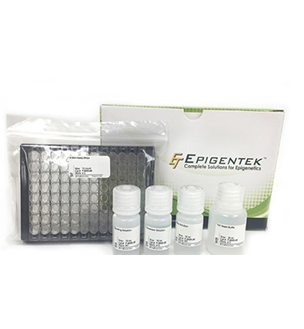
透明質(zhì)酸酶聯(lián)免疫吸附測定(HA ELISA)是一種競爭性96孔板檢測方法,提供了一種簡單、有效的方法,用于測定人和動物生物樣本或細(xì)胞上清液中的透明質(zhì)酸(HA)水平。
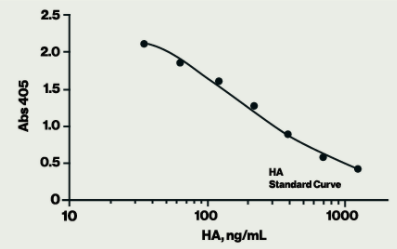
艾美捷透明質(zhì)酸酶聯(lián)免疫吸附測定(HA ELISA):
貨號:K-1200
檢測范圍:50-1600 ng/ml
靈敏度:25 ng/mL
樣本注意事項(xiàng):HA ELISA能夠檢測小至6.4 kDa的HA分子。
關(guān)鍵詞:透明質(zhì)酸、肝硬化、類風(fēng)濕關(guān)節(jié)炎、骨關(guān)節(jié)炎、肝纖維化
分類:試劑盒與檢測
篩選:細(xì)胞外基質(zhì)、ELISA、透明質(zhì)酸
運(yùn)輸溫度:凝膠冰
儲存:4-8°C
透明質(zhì)酸酶聯(lián)免疫吸附測定(HA ELISA)文獻(xiàn)參考:
1. Meuwese, M. C., H. L. Mooij, et al. (2009). “Partial recovery of the endothelial glycocalyx upon rosuvastatin therapy in patients with heterozygous familial hypercholesterolemia.” J Lipid Res 50(1): 148-153.
2. Vendrov, A. E., N. R. Madamanchi, et al. (2010). “NADPH Oxidases Regulate CD44 and Hyaluronic Acid Expression in Thrombin-treated Vascular Smooth Muscle Cells and in Atherosclerosis.” Journal of Biological Chemistry 285(34): 26545-26557.
3. B. KIM, et al. (2010). “Retinyl retinoate induces hyaluronan production and less irritation than other retinoids.” The Journal of Dermatology 37(5): 448-454.
4. Haserodt, S., M. Aytekin, et al. (2011). “A comparison of the sensitivity, specificity, and molecular weight accuracy of three different commercially available Hyaluronan ELISA-like assays.” Glycobiology 21(2): 175-183.
5. Hill, D. R., H. K. Rho, et al. (2013). “Human Milk Hyaluronan Enhances Innate Defense of the Intestinal Epithelium.” Journal of Biological Chemistry 288(40): 29090-29104.
6. Measurement of low-molecular weight HA: Schmaus, A, Klusmeier, S. et al (2014) “Accumulation of small hyaluronan oligosaccharides in tumour interstitial fluid correlates with lymphatic invasion and lymph node metastasisBr. J. Cancer 111(3): 559-567
7. Tang, S. C., S. J. Yeh, et al. (2014). “Association between plasma levels of hyaluronic acid and functional outcome in acute stroke patients.” J Neuroinflammation 11: 101.
8. Measuring HA mass distribution: Yuan, H., R. Amin, et al. (2015). “Determination of hyaluronan molecular mass distribution in human breast milk.” Analytical Biochemistry 474: 78-88.

產(chǎn)品訂購:sales@amyjet.com
郵政編碼:430070
公司地址:武漢市洪山區(qū)光谷大道35號
光谷總部國際二期時代1棟13樓
提示:本公司所有產(chǎn)品僅供科研使用,不用于臨床診斷。
版權(quán)所有:艾美捷科技有限公司 鄂ICP備10204150號-1 鄂公網(wǎng)安備:42018502004523號
第二類醫(yī)療器械經(jīng)營備案憑證:鄂漢藥監(jiān)械經(jīng)營備20234324號

微信掃碼在線客服