AGENT BRAND
品牌專題
AAT Bioquest產(chǎn)品Calbryte 520 AM(貨號(hào)20650)
1. 產(chǎn)品基本信息
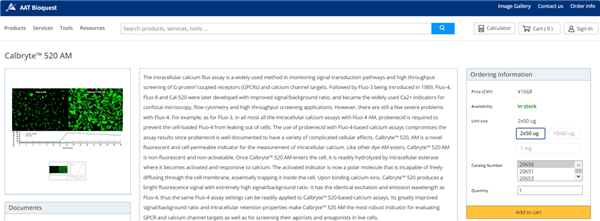
Calbryte 520 AM(貨號(hào):20650)是 AAT Bioquest 公司開(kāi)發(fā)的細(xì)胞滲透性熒光鈣離子(Ca2+)指示劑,專為實(shí)時(shí)監(jiān)測(cè)活細(xì)胞內(nèi)鈣離子濃度動(dòng)態(tài)變化設(shè)計(jì)。該產(chǎn)品具備高靈敏度、低細(xì)胞毒性及多熒光探針兼容性等特性,廣泛應(yīng)用于生命科學(xué)研究領(lǐng)域。
2. 化學(xué)性質(zhì)與工作原理
2.1 化學(xué)結(jié)構(gòu)
Calbryte 520 AM 為乙酰氧基甲酯(AM)衍生物,可通過(guò)被動(dòng)擴(kuò)散進(jìn)入細(xì)胞。細(xì)胞內(nèi)酯酶水解 AM 保護(hù)基團(tuán)后,釋放出游離的 Calbryte 520 熒光團(tuán),其與 Ca??結(jié)合后熒光強(qiáng)度顯著增強(qiáng)。
2.2 光譜特性
· 激發(fā)波長(zhǎng)(λEx):488 nm(兼容藍(lán)光激光)
· 發(fā)射波長(zhǎng)(λEm):515–540 nm(綠色熒光范圍)
· 熒光增強(qiáng)特性:與 Ca??結(jié)合時(shí)熒光信號(hào)提升超 100 倍,信噪比(SNR)優(yōu)異
· 親和力:對(duì) Ca??的解離常數(shù)(Kd)約為 1–2 μM,屬于低親和力染料,適用于檢測(cè)快速、高幅度的鈣瞬變,避免高親和力染料(如 Fura-2)的飽和問(wèn)題 。
3. 核心優(yōu)勢(shì)
1. 長(zhǎng)時(shí)程穩(wěn)定性:相較于傳統(tǒng)染料 Fluo-4 AM,Calbryte 520 AM 在細(xì)胞內(nèi)保留時(shí)間長(zhǎng)達(dá) 24 小時(shí),無(wú)需額外添加有機(jī)陰離子轉(zhuǎn)運(yùn)抑制劑(如 probenecid)
2. 多通道兼容性:光譜特性支持與紅色熒光探針(如用于肌質(zhì)網(wǎng)鈣成像的 R-CEPIA1SR)同步使用,實(shí)現(xiàn)雙通道鈣信號(hào)監(jiān)測(cè)
3. 高靈敏度與低背景:水解后的熒光團(tuán)與 Ca??結(jié)合后產(chǎn)生強(qiáng)熒光信號(hào),背景干擾低,尤其適合活細(xì)胞動(dòng)態(tài)成像
4. 應(yīng)用場(chǎng)景與實(shí)驗(yàn)案例
4.1 心血管研究
· 心肌細(xì)胞鈣動(dòng)力學(xué):用于人誘導(dǎo)多能干細(xì)胞分化心肌細(xì)胞(hiPSC-CMs)的胞質(zhì)鈣濃度監(jiān)測(cè),結(jié)合 R-CEPIA1SR 探針同步檢測(cè)肌質(zhì)網(wǎng)鈣釋放,解析心律失常機(jī)制(如兒茶酚胺敏感性多形性室速,CPVT)。
· 鈣瞬變與動(dòng)作電位同步記錄:與膜電位探針 FluoVolt 聯(lián)用,實(shí)現(xiàn)鈣信號(hào)(Calbryte 520)與動(dòng)作電位(FluoVolt)的雙通道光學(xué)映射(100–1000 fps)。
4.2 神經(jīng)科學(xué)
· 神經(jīng)元光熱刺激研究:在 Ti3C2Tx MXene 材料介導(dǎo)的神經(jīng)刺激實(shí)驗(yàn)中,實(shí)時(shí)監(jiān)測(cè)背根神經(jīng)節(jié)(DRG)神經(jīng)元在光熱刺激下的鈣內(nèi)流,驗(yàn)證神經(jīng)興奮性。
· 鈣信號(hào)與凋亡關(guān)聯(lián)研究:通過(guò)巨噬細(xì)胞鈣成像,分析炎癥或藥物處理后的鈣響應(yīng)。
4.3 腫瘤與免疫學(xué)
· 腫瘤細(xì)胞鈣通量檢測(cè):評(píng)估電磁場(chǎng)(如 5 mT 低頻磁場(chǎng))對(duì)腫瘤細(xì)胞內(nèi)鈣濃度的影響,揭示其抑制腫瘤生長(zhǎng)的機(jī)制 。
· 免疫細(xì)胞激活分析:在骨髓中性粒細(xì)胞(BMNs)中,監(jiān)測(cè)血小板活化因子(PAF)刺激下的鈣信號(hào)動(dòng)態(tài),研究藥物(如人參皂苷 Rg5)的調(diào)控作用 。
4.4 骨與組織工程
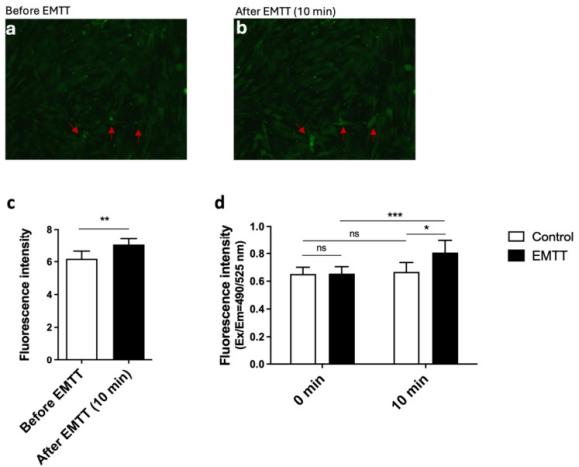
· 成骨細(xì)胞鈣響應(yīng):在電磁治療(EMTT)研究中,檢測(cè)骨祖細(xì)胞(hOBs)內(nèi)鈣濃度升高,驗(yàn)證電場(chǎng)促進(jìn)骨礦化的機(jī)制 。
5. 實(shí)驗(yàn)操作指南
5.1 染色步驟
1. 染料配制:將 Calbryte 520 AM 溶于含 0.04% Pluronic F-127 的緩沖液(如 HBSS 或 KRP-HEPES),終濃度通常為 5 μM。
2. 孵育條件:37°C 避光孵育 30–60 分鐘,隨后室溫平衡 15–30 分鐘以促進(jìn)酯酶水解。
3. 洗滌與成像:用緩沖液洗滌 3 次后,在熒光顯微鏡或微孔板讀數(shù)儀(激發(fā) / 發(fā)射:490/525 nm)中觀察信號(hào)。
5.2 注意事項(xiàng)
· 需避免長(zhǎng)時(shí)間光照,以防止熒光探針發(fā)生光漂白現(xiàn)象。
· 實(shí)驗(yàn)設(shè)計(jì)中需設(shè)置陰性對(duì)照(如未染色細(xì)胞)和陽(yáng)性刺激(如離子霉素),以驗(yàn)證染料響應(yīng) 。
6. 與其他鈣染料的對(duì)比
| 特性 | Calbryte 520 AM | Fluo-4 AM | Rhod-2 AM |
| 親和力(Kd) | ~1–2 uM(低) | ~345 nM(高) | ~1 uM(中等) |
| 保留時(shí)間 | 長(zhǎng)達(dá) 24 小時(shí)(無(wú)需 probenecid) | 需 probenecid 延長(zhǎng)保留 | 中等 |
| 多通道兼容性 | 兼容紅色探針(如 R-CEPIA) | 需避免光譜重疊 | 適合單通道成像 |
| 典型應(yīng)用場(chǎng)景 | 快速鈣瞬變、長(zhǎng)時(shí)程實(shí)驗(yàn) | 穩(wěn)態(tài)鈣濃度檢測(cè) | 線粒體鈣監(jiān)測(cè) |
總結(jié)
Calbryte 520 AM 憑借長(zhǎng)時(shí)程穩(wěn)定性、低背景噪聲和廣泛兼容性,成為活細(xì)胞鈣成像的優(yōu)選工具。其在心血管疾病機(jī)制研究、神經(jīng)興奮性調(diào)控及腫瘤治療策略開(kāi)發(fā)等領(lǐng)域展現(xiàn)出顯著應(yīng)用潛力。更多產(chǎn)品問(wèn)題,歡迎咨詢AAT Bioquest中國(guó)區(qū)總代理,艾美捷科技,m.zihai029.com
參考文獻(xiàn)
1. R. Li, Jiahui Liu et al. “Transformable nano-antibiotics for mechanotherapy and immune activation against drug-resistant Gram-negative bacteria.” Science Advances
2. H. Onimaru, M. Dutschmann. “Calcium imaging of neuronal activity in the most rostral parafacial respiratory group of the newborn rat.” The Journal of Physiological Sciences
3. Charles A. Swofford, S. Nordeen et al. “Structure and specificity of an anti‐chloramphenicol single domain antibody for detection of amphenicol residues.” Protein Science : A Publication of the Protein Society
4. A. Spano, L. Sciola. “Polyploid cell dynamics and death before and after PEG-treatment of a NIH/3T3 derived culture: vinblastine effects on the regulation of cell subpopulations heterogeneity.” Cell Division
5. Long Zhang, Wan Zhang et al. “Bioactive cytomembrane poly(citrate-peptide)-miRNA365 nanoplatform with immune escape and homologous targeting for colon cancer therapy.” Materials Today Bio
6. Liping Li, Jia Wang et al. “ADP-Hep-Induced Liquid Phase Condensation of TIFA-TRAF6 Activates ALPK1/TIFA-Dependent Innate Immune Responses.” Research
7. D. Karageorgou, P. Zygouri et al. “Green Synthesis and Characterization of Silver Nanoparticles with High Antibacterial Activity Using Cell Extracts of Cyanobacterium Pseudanabaena/Limnothrix sp..” Nanomaterials
8. Gillian A. Gulette, Daniel T. Hass et al. “Reassessing Retinal Pigment Epithelial Ketogenesis: Enzymatic Assays for Ketone Body Levels Provide Inaccurate Results.” bioRxiv
9. Wei-Tao Dou, Hai-Hao Han et al. “Fluorescent probes for the detection of disease-associated biomarkers..” Science bulletin
10. Guanhua Bai, Yu Wang et al. “Gephyrin-mediated formation of inhibitory postsynaptic density sheet via phase separation.” Cell Research
11. G. Knoll, S. Bittner et al. “Hypoxia regulates TRAIL sensitivity of colorectal cancer cells through mitochondrial autophagy.” Oncotarget
12. M. P. Maela, Hendri?tte van der Walt et al. “The Antibacterial, Antitumor Activities, and Bioactive Constituents’ Identification of Alectra sessiliflora Bacterial Endophytes.” Frontiers in Microbiology
13. Andrew A. Lin, Hanfei Shen et al. “Parallelized immunomagnetic nanopore sorting: modeling, scaling, and optimization of surface marker specific isolation of extracellular vesicles from complex media.” Research Square
14. Ya-Hui Chen, Jyun-Xue Wu et al. “Synergistic Combination of Luteolin and Asiatic Acid on Cervical Cancer In Vitro and In Vivo.” Cancers
15. M. Yousuf, Anas Shamsi et al. “Ellagic Acid Controls Cell Proliferation and Induces Apoptosis in Breast Cancer Cells via Inhibition of Cyclin-Dependent Kinase 6.” International Journal of Molecular Sciences
16. Xiufei Cao, Huixing Guo et al. “Excessive linoleic acid induces muscle oxidative stress through 5-lipoxygenase-dependent peroxidation.” Redox Biology
17. S. B. Lohan, K. Bühring et al. “Analysis of the Status of the Cutaneous Endogenous and Exogenous Antioxidative System of Smokers and the Short-Term Effect of Defined Smoking Thereon.” Antioxidants
18. J. Myung, K. Gajjar et al. “Differential Detection of Tumor Cells Using a Combination of Cell Rolling, Multivalent Binding, and Multiple Antibodies.” Analytical Chemistry
19. Y. Tomita, Eric Smith et al. “In Vitro Synergistic Inhibition of HT-29 Proliferation and 2H-11 and HUVEC Tubulogenesis by Bacopaside I and II Is Associated with Ca2+ Flux and Loss of Plasma Membrane Integrity.” Pharmaceuticals
20. X. Butova, T. Myachina et al. “A combined Langendorff-injection technique for simultaneous isolation of single cardiomyocytes from atria and ventricles of the rat heart.” MethodsX
21. M. Rath, Konrad Schwefel et al. “Contact-dependent signaling triggers tumor-like proliferation of CCM3 knockout endothelial cells in co-culture with wild-type cells.” Cellular and Molecular Life Sciences: CMLS
22. S. Takashima, S. Usui et al. “Myocyte-specific enhancer factor 2c triggers transdifferentiation of adipose tissue-derived stromal cells into spontaneously beating cardiomyocyte-like cells.” Scientific Reports
23. Zhang Tao, Yuqian He et al. “Photomodulation alleviates cellular senescence of aging adipose-derived stem cells.” Cell Communication and Signaling : CCS
24. Rahul Peswani. “Mechanisms regulating adult neurogenesis in the hypothalamus using a genetic inducible-approach to label and optogenetically stimulate hypothalamic neural progenitors.”
25. A. Croitoru, Alina Moro?an et al. “Novel Graphene Oxide/Quercetin and Graphene Oxide/Juglone Nanostructured Platforms as Effective Drug Delivery Systems with Biomedical Applications.” Nanomaterials
26. Baoxiang Chen, Yanrong Deng et al. “Metabolic Recoding of NSUN2‐Mediated m5C Modification Promotes the Progression of Colorectal Cancer via the NSUN2/YBX1/m5C‐ENO1 Positive Feedback Loop.” Advanced Science
27. Judit R. Pungor, V. A. Allen et al. “Functional organization of visual responses in the octopus optic lobe.” bioRxiv
28. Jie Lu, B. Montgomery et al. “Corticotropin releasing hormone can selectively stimulate glucose uptake in corticotropinoma via glucose transporter 1.” Molecular and Cellular Endocrinology
29. Katie Davis-Anderson, Sofiya N Micheva-Viteva et al. “CRISPR/Cas9 Directed Reprogramming of iPSC for Accelerated Motor Neuron Differentiation Leads to Dysregulation of Neuronal Fate Patterning and Function.” International Journal of Molecular Sciences
30. Glycoproteins Isolated from Tongkat Ali Plants Capable to Elevate Testosterone in both in vitro and in vivo Experiments.Tropical Journal of Natural Product Research
31. Yingqiao Wang, Raghav Garg et al. “Ti3C2Tx MXene Flakes for Optical Control of Neuronal Electrical Activity.” ACS Nano
32. Yawen Tang, Sajesan Aryal et al. “TBX20 Improves Contractility and Mitochondrial Function During Direct Human Cardiac Reprogramming.” Circulation
33. Rahul V G, Govindaraj Ellur et al. “4-aminopyridine attenuates inflammation and apoptosis and increases angiogenesis to promote skin regeneration following a burn injury in mice.” Cell Death Discovery
34. Alia Arslanova, Sanam Shafaattalab et al. “Using hiPSC‐CMs to Examine Mechanisms of Catecholaminergic Polymorphic Ventricular Tachycardia.” Current Protocols

產(chǎn)品訂購(gòu):sales@amyjet.com
郵政編碼:430070
公司地址:武漢市洪山區(qū)光谷大道35號(hào)
光谷總部國(guó)際二期時(shí)代1棟13樓
提示:本公司所有產(chǎn)品僅供科研使用,不用于臨床診斷。
版權(quán)所有:艾美捷科技有限公司 鄂ICP備10204150號(hào)-1 鄂公網(wǎng)安備:42018502004523號(hào)
第二類醫(yī)療器械經(jīng)營(yíng)備案憑證:鄂漢藥監(jiān)械經(jīng)營(yíng)備20234324號(hào)
友情鏈接:亞科因生物每日生物評(píng)論

微信掃碼在線客服