PRODUCT CENTER
特色產品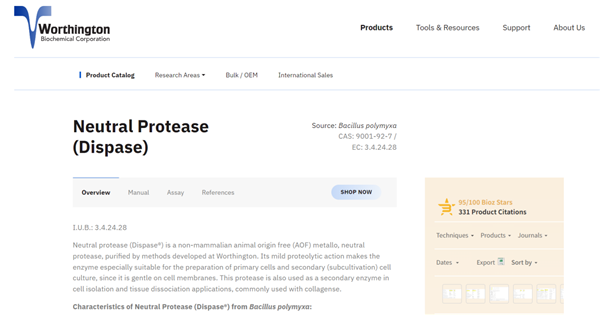
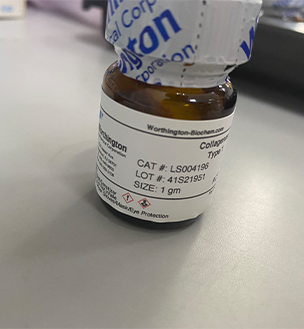
中性蛋白酶(Dispase)是一種無哺乳動物源(AOF)的金屬中性蛋白酶,采用沃辛頓公司研發(fā)的方法進行純化。其溫和的蛋白水解作用使該酶特別適合用于原代細胞和傳代(繼代培養(yǎng))細胞培養(yǎng)的制備,因為它對細胞膜較為溫和。這種蛋白酶還可作為細胞分離和組織解離應用中的輔助酶,通常與膠原酶一起使用。
產品核心特性:
·來源:細菌 Bacillus polymyxa,切割纖維連接蛋白(Fibronectin)和 IV 型膠原,溫和解離細胞間連接。
·適用場景:所有規(guī)格通用,包括心臟組織消化、神經細胞分離、腫瘤微環(huán)境分析和內皮/上皮細胞分離。
·優(yōu)勢: 活性不受血清抑制,對細胞損傷小,適合活細胞實驗(如 scRNA-seq、流式細胞術);不含動物源性成分,符合臨床前研究標準。
心臟組織消化 與膠原酶 IV 和 DNase I 聯(lián)用,用于心肌細胞和血管內皮細胞分離 | 神經細胞分離 背根神經節(jié)(DRG)、中樞神經元或小膠質細胞解離 | 腫瘤微環(huán)境分析 實體瘤組織消化(與膠原酶/DNase I 聯(lián)用) |
三款貨號的差異(僅包裝規(guī)格不同)
| 貨號 | 包裝量 | 儲存形式 | 適用實驗規(guī)模 |
| LS02100 | 1 克 | 凍干粉 | 小規(guī)模實驗(單次或少量樣本) |
| LS02104 | 5 克 | 凍干粉 | 中規(guī)模研究(多次實驗或高通量篩選) |
| LS02106 | 25 克 | 凍干粉 | 大規(guī)模生產或長期需求(工業(yè)級) |
典型應用方法(所有規(guī)格通用)
1. 心臟組織解離:
·濃度:1.2 U/mL(或 100 μg/mL)
·緩沖液:含 Ca??/Mg??的 DPBS
·聯(lián)用酶:膠原酶 IV(LS004186) + DNase I(LS002007)
·條件:37°C 消化 40-45 分鐘。
2. 神經組織解離:
·濃度:0.7 U/mL(或 50-100 μg/mL)
·聯(lián)用酶:膠原酶 + DNase I(DRG) 或 木瓜蛋白酶(腦/脊髓組織)
·條件:37°C 或低溫 25°C(神經元保護)。
3. 腫瘤組織解離:
·濃度:0.5-2.0 mg/mL(依組織硬度調整)
·聯(lián)用酶:膠原酶(LS004154) + DNase I
·條件:37°C 消化 30-60 分鐘。
根據組織類型調整濃度:
·高硬度組織(如實體瘤、成體心臟):1-2 mg/mL。
·脆弱組織(如胚胎組織、神經元):0.5-1 mg/mL。
其它產品信息:
| 特性 | 詳情 |
| 分子量 | 36 千道爾頓(kDa) |
| 最適 pH | 在較寬 pH 范圍(4.0-9.0)內穩(wěn)定,最適 pH 為 5.9-7.0 |
| 穩(wěn)定性 / 儲存條件 | 2-8°C 下可穩(wěn)定保存 12 個月;用水或常用平衡鹽溶液 / 培養(yǎng)基復溶后需分裝并凍存于 - 20°C |
| 特異性 | 非特異性切割含有亮氨酸(Leu)和苯丙氨酸(Phe)的肽鍵 |
| 激活劑 | 二價陽離子(如 Ca2+、Mg2+、Mn2+、Fe2+) |
| 抑制劑 | EDTA(1mM)、EGTA、1-10 - 鄰菲羅啉及重金屬離子 |
| 應用 | 常用于分離表皮與真皮(保留完整上皮層)、干細胞、肝細胞及其他細胞的分離; 由于涉及變量多樣性,具體分離條件需針對每種細胞 / 組織通過實驗確定 |
參考文獻:
1. PDFM. Corrales, Benjamin T. Cocanougher et al. “A single-cell transcriptomic atlas of complete insect nervous systems across multiple life stages.” Neural Development[2022-08-24]
2. U. Laemmli. “Cleavage of Structural Proteins during the Assembly of the Head of Bacteriophage T4.” Nature[1970-08-15]
3. PDFO. H. Lowry, N. J. Rosebrough et al. “Protein measurement with the Folin phenol reagent..” The Journal of biological chemistry[1951-11-01]
4. PDFBenjamin T. Cocanougher, J. Wittenbach et al. “Comparative single-cell transcriptomics of complete insect nervous systems.” bioRxiv[2019-09-30]
5. PDFSelina M Garcia, J. Naik et al. “Acid-sensing ion channel 1a activates IKCa/SKCa channels and contributes to endothelium-dependent dilation.” The Journal of General Physiology[2022-12-09]
6. PDFEdgar Creus-Bachiller, J. Fernández-Rodríguez et al. “Expanding a precision medicine platform for malignant peripheral nerve sheath tumors: New patient‐derived orthotopic xenografts, cell lines and tumor entities.” Molecular Oncology[2023-10-05]
7. PDFSiyeon Rhee, D. Paik et al. “Endocardial/endothelial angiocrines regulate cardiomyocyte development and maturation and induce features of ventricular non-compaction.” bioRxiv[2020-07-26]
8. PDFA. Pippow. “Differences of Ca2+ Handling Properties and Differential Processing of Olfactory Information in Identified Central Olfactory Neurons.”[2008-05-16]
9. PDFTianying Su, Geoffrey M. Stanley et al. “Single cell analysis of early progenitor cells that build coronary arteries.” Nature[2018-05-30]

產品訂購:sales@amyjet.com
郵政編碼:430070
公司地址:武漢市洪山區(qū)光谷大道35號
光谷總部國際二期時代1棟13樓
提示:本公司所有產品僅供科研使用,不用于臨床診斷。
版權所有:艾美捷科技有限公司 鄂ICP備10204150號-1 鄂公網安備:42018502004523號
第二類醫(yī)療器械經營備案憑證:鄂漢藥監(jiān)械經營備20234324號

微信掃碼在線客服