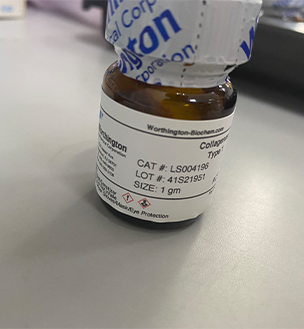
Collagenase preparations contain several isoforms of two different collagenases, a sulfhydryl protease, clostripain, a trypsin-like enzyme, and an aminopeptidase. This combination of collagenolytic and proteolytic activities is effective at breaking down intercellular matrices, the essential part of tissue dissociation. Crude collagenases are widely used in enzymatic primary cell isolation and tissue dissociation procedures. Most researchers employ either crude collagenase preparations such as Types 1, 2, 3, and 4 or chromatographically purified collagenase; the latter usually combined with secondary enzymes such as elastase, hyaluronidase, etc. Elastase is a serine protease that also hydrolyzes amides and esters. It is produced in the pancreas as an inactive zymogen, and activated in the duodenum by trypsin. The following information applies to porcine elastase. While elastase will hydrolyze a wide variety of protein substrates, it is unique among proteases in its ability to hydrolyze native elastin, a substrate not attacked by trypsin, chymotrypsin or pepsin. Soybean trypsin inhibitor and kallikrein inhibitor suppress proteolytic but not elastolytic activity. Collagenase is ideal for researches focused in Stem Cell and Biomarker Research.
Store vial at 2 - 8 ° C prior to opening. Aliquot contents and freeze at -20° C or below for extended storage. Avoid cycles of freezing and thawing. Centrifuge product if not completely clear after standing at room temperature. Dilute only prior to immediate use.